
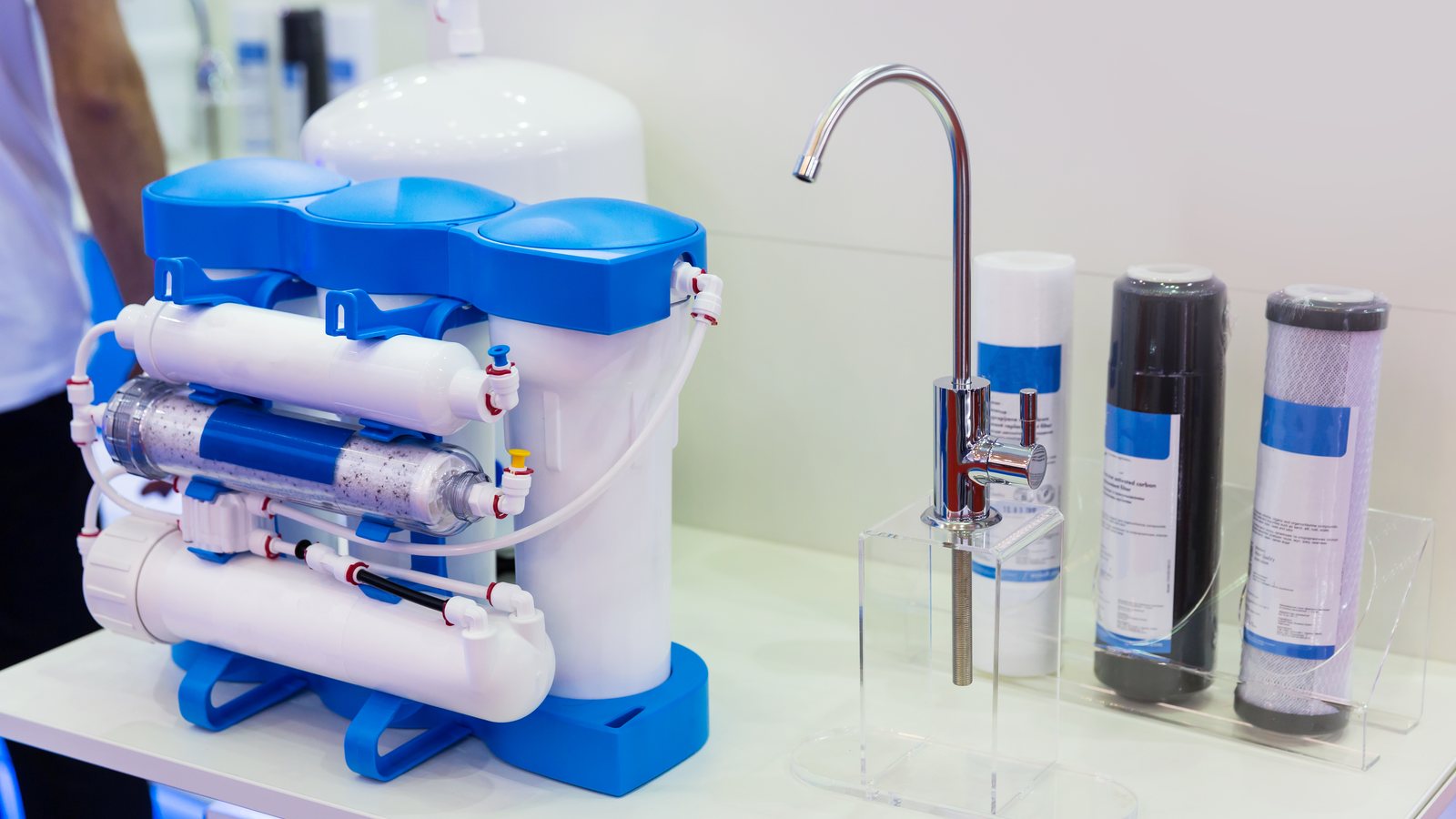
The phrase “reverse osmosis” often appears alongside filters, purifiers and UV systems as though these technologies were versions of the same solution. They are not. Each performs a different function, and none should be selected only because its name is familiar or because a unit has many stages.
The useful question is more specific: which water parameter must be reduced or controlled, where will the water be used, and how will the result be verified? Representative testing can distinguish suspended solids, dissolved substances, taste or odor concerns and microbiological risk. Those findings can guide an assessment of a reverse-osmosis membrane, filtration media, a UV stage or a treatment train combining several barriers.
What reverse osmosis does
Reverse osmosis is a membrane-separation process. Pressure moves feed water through a semipermeable membrane. One portion crosses the membrane and becomes treated water, or permeate; another leaves as concentrate or reject water and carries a share of the separated substances.
The U.S. Environmental Protection Agency (EPA) explains that reverse osmosis can reduce a broad range of constituents, including many salts and dissolved solids, inorganic substances and selected organic compounds. This describes what the technology can do under design conditions; it does not mean every membrane removes every substance or that every system produces the same result.
Performance depends on membrane type, incoming water quality and temperature, pressure, recovery, fouling and system condition. The reduction claim for the specific model should therefore be compared with the parameter found in testing. If the objective is to reduce a particular substance, a generic phrase such as “high-quality membrane” is not enough.
What filtration does
“Filtration” covers very different processes. A screen or sediment cartridge retains particles within a range of sizes and loading conditions. Granular media may help control turbidity. Activated carbon works primarily through adsorption and may reduce certain compounds associated with taste, odor or defined chemical objectives. Pore size, material, contact time, flow and the media’s finite capacity all change the result.
A particle filter does not automatically replace a membrane when the concern is dissolved salts. Likewise, an improvement in taste does not demonstrate microbiological compliance. Guidance from the U.S. Centers for Disease Control and Prevention (CDC) emphasizes that different systems address different germs or chemicals and recommends selecting treatment around the identified concern.
Filtration may also protect a later stage. Reducing solids before a membrane can limit plugging, while clarifying water before an optical process can help radiation reach the treatment zone. The type and degree of prefiltration must still match the source and equipment rather than a universal sequence.
What a UV stage does
Ultraviolet light is used to disinfect or reduce microorganisms under defined conditions. It does not separate dissolved salts and should not be presented as a substitute for a membrane when the objective is dissolved solids or another chemical substance. CDC also notes that UV systems work better with prefiltration and that UV light leaves no continuing disinfectant effect in downstream pipes or storage.
Performance requires the radiation to reach the water at the intended intensity and exposure. Turbidity, color, surface fouling, UV-source aging and flow can change those conditions. A project must therefore define incoming quality, monitoring, cleaning, replacement and verification testing.
UV + TiO₂ photocatalysis adds an advanced-oxidation mechanism and is not the same as a conventional UV lamp. See our separate explanation of how UV + TiO₂ photocatalysis works and the limits of the available evidence.
A quick comparison by objective
| Measured concern or objective | Process that may be assessed | Verification question |
|---|---|---|
| Sand, sediment or suspended solids | Screen, cartridge or media selected for particle size and loading | What range does it retain, at what flow and pressure loss? |
| Odor, taste or an identified adsorbable compound | Activated carbon or another suitable adsorptive medium | Do capacity and contact time match the compound and concentration? |
| Salts, dissolved solids or a contaminant compatible with the membrane | Reverse osmosis or another membrane-separation process | What reduction does the model claim, under what incoming quality and with how much reject water? |
| A defined microbiological concern | Sanitary correction, pretreatment and disinfection, which may include UV | Which dose or operating condition will be controlled, and how will treated water be tested? |
| Several concerns at once | A treatment train designed in stages | Which finding justifies each barrier, and how does it protect the next stage? |
The table frames the discussion but does not prescribe equipment. The same commercial label may combine cartridges, carbon, a membrane, a tank and a faucet, while another system treats all incoming water. The process, point of application and verified capacity of each component must be distinguished.
There is no universal winner: the objectives differ
Reverse osmosis may be relevant when testing identifies a separation objective compatible with the membrane. It may be unnecessary when the only concern is coarse sediment that a simpler stage can address. UV may suit a microbiological objective, but it does not correct salinity or hardness by itself. Carbon media may address selected compounds or sensory characteristics, but exhaustion of the media must be managed.
Many projects use a combination. One conceptual example might include prefiltration to protect the membrane, reverse osmosis for a dissolved-substance objective and a disinfection stage where the risk assessment justifies one. This is not a recipe: the order, sizing and need for each stage change with the source, intended use and distribution system.
For a broader explanation of how laboratory findings map to treatment functions, read our guide to choosing water filters in Panama. To clarify the commercial terminology, see what “water purifier” really means.
Operational questions that come with reverse osmosis
A membrane should not be assessed only by a rejection percentage. A proposal should explain required pressure, permeate flow, the share of concentrate, pretreatment, scaling or fouling risk, cleaning, consumables, expected service life and responsible reject-water management. It should also state whether the treated water needs post-treatment for pH, corrosion control or its final use.
For point-of-use systems, tank volume and real production rate should be compared with demand. EPA WaterSense information on point-of-use reverse osmosis illustrates why buyers should ask for the exact treated-to-reject-water relationship and review verified reduction claims for the model. WaterSense is a U.S. program and does not replace requirements or assessment applicable in Panama.
Concentrate does not disappear: it contains a portion of what the membrane separated. Its volume and disposal belong in the design. At larger scales, energy, recovery, cleaning, pretreatment quality and discharge control also matter. These variables rule out promising universal efficiency or water quality without project data.
What to review in Panama before choosing
RT DGNTI-COPANIT 21-2019 establishes definitions and general requirements for drinking water in Panama. It concerns the water quality that must be evaluated; it does not make a brand or technology suitable for every source.
Before comparing proposals, identify the source, intended use and sampling point. Request microbiological, physical and chemical parameters relevant to local risks. Record daily use, peak flow, pressure, space, energy and available drainage. If water comes through a tank, well or internal network, include the sanitary condition of that infrastructure.
After installation, test the parameters that justified treatment. Verification needs a sampling location, date, method and acceptance criterion. It also needs a maintenance schedule. One initial result does not show that a system will keep working the same way if incoming water changes or media become exhausted.
A short checklist for comparing proposals
- Which test result justifies reverse osmosis, filtration or the UV stage?
- Which parameters remain outside the system’s scope?
- What are the design incoming quality, pressure and flow?
- How much permeate and concentrate does the membrane produce under those conditions?
- Which cartridges, media, membranes or UV sources are replaced, and when?
- How will each objective be verified after commissioning?
- What action follows if treated water does not meet the agreed criterion?
Ice Innova Panama can review available testing, intended use, demand and site conditions to identify which technologies are worth assessing. Request a technical assessment with your results and operating information; the discussion should begin with the measured problem, not a predetermined solution.
Sources and scope
This article uses the Panamanian regulation as a water-quality reference and official technical sources from the U.S. CDC and EPA to explain treatment functions. The CDC description of water treatment also shows that systems commonly combine separation, filtration and disinfection according to source-water quality. U.S. guidance provides context and does not replace regulations, testing or professional design applicable in Panama.