
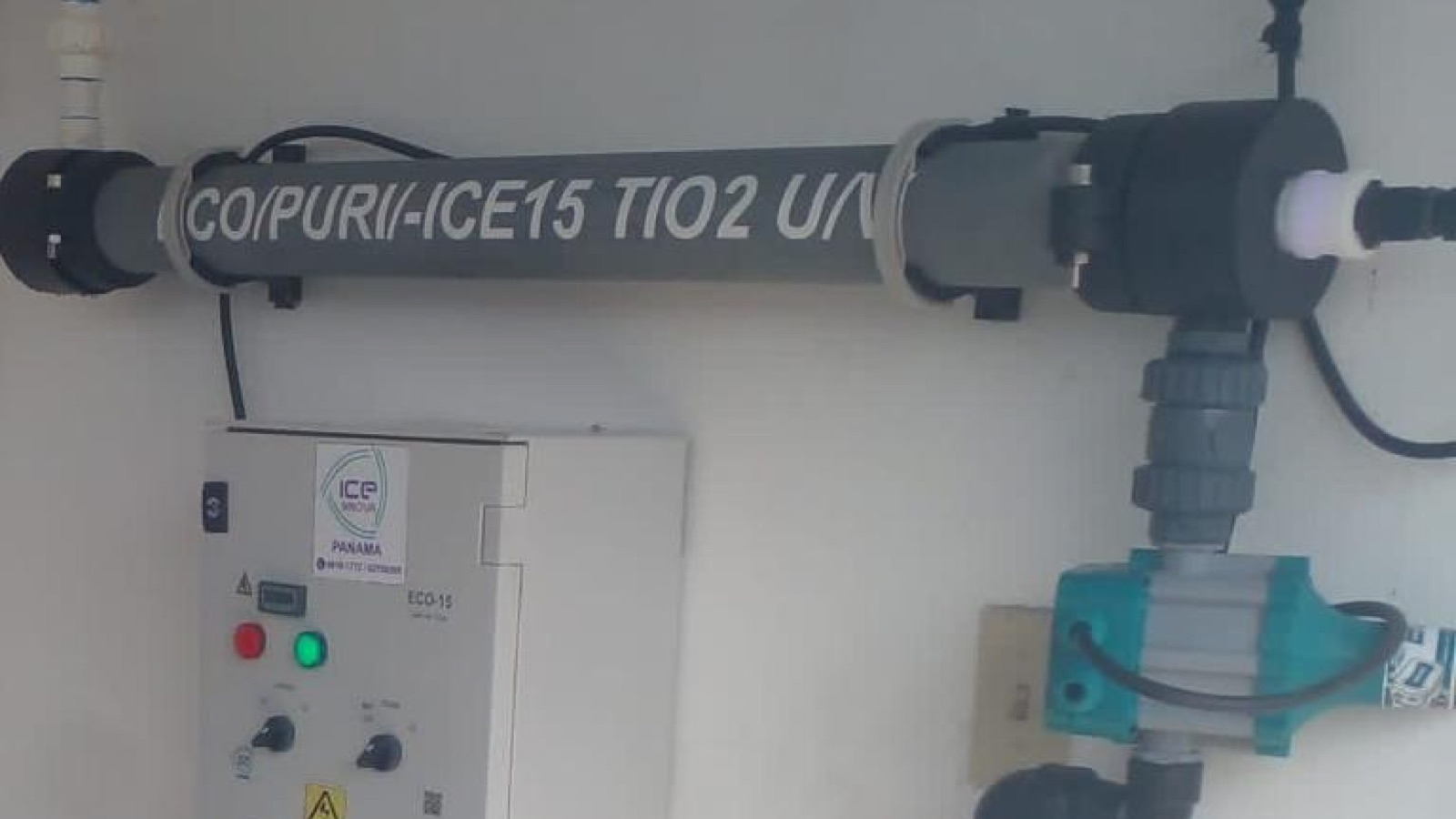
Ultraviolet light combined with titanium dioxide—UV + TiO₂—is an advanced oxidation technology. Its purpose is to generate reactive species inside a reactor that can act on defined targets in water. It is not a universal remedy: performance depends on incoming water quality, hydraulic design, exposure time, equipment condition and the way each installation is verified.
Available ICE15 documentation describes a treatment line combining preliminary filtration with a titanium reactor whose surface incorporates TiO₂ and is exposed to 254-nanometer UV-C light. Understanding what each stage does—and what the evidence does not establish—makes it possible to assess the technology without turning particular test results into general promises.
What happens during photocatalysis?
TiO₂ is a semiconductor material. When light provides sufficient energy, its surface becomes activated and reactions take place with nearby water and oxygen. These reactions can generate short-lived, highly reactive species, including hydroxyl radicals.
Those species may interact with susceptible biological structures or molecules close to the illuminated surface. This is the core principle of photocatalysis for water treatment. The UV-C source also participates in the disinfection process described for the equipment, but the combined result should not automatically be extrapolated to every microorganism, substance or type of water.
Explaining the mechanism is also not enough to say that an entire installation operates without any chemical inputs. Water preparation, cleaning, maintenance or other stages may use different substances depending on the project. The controlled experiment discussed below, for example, used chlorine during preparation and then neutralized it before introducing the bacteria. A responsible account documents the whole treatment train and the role of each barrier.
The process documented for ICE15
In simplified terms, water first passes through filtration and then through the UV + TiO₂ reactor. The De La Cruz and Murcia publication describes a screen, a multilayer filter and the reactor. Preliminary filtration can retain material according to the screen or media installed and may help the water reach the reactor under more favorable conditions.
This does not mean that the stage removes dissolved salts, metals, every microorganism or particular compounds. Each removal claim requires suitable media, operating conditions and evidence.
A 2022 technical sheet supplied by ICE Innova lists an ASTM B861 grade 2 titanium reactor, lamp, quartz, plastic and control components, a rotameter scaled from 600 to 6,000 liters per hour and a filter rated at 6 m³/h. These are stated component specifications. They are not independent certification and do not prove the effective capacity of the complete system for every water source. Historical documents contain conflicting flow and power figures, so a current project must be sized using model-, site- and water-specific data rather than a universal published capacity.
Why turbidity, flow and maintenance matter
Radiation must reach the reactor’s active area. Suspended solids, color and other constituents may reduce light transmission or partially shield microorganisms. Surface fouling, lamp aging and inadequate preliminary filtration can also change performance.
Flow affects residence time and the hydraulic conditions inside the reactor. A number printed on a meter or component sheet does not demonstrate the same microbiological result across that full range. Establishing an operating flow requires water-quality data, a measurable objective and testing under representative conditions.
Maintenance is part of the treatment process, not an optional task afterward. Inspection, cleaning, media replacement, UV-source monitoring and verification analysis should be defined. If turbidity, source or demand changes, the configuration may need to be reassessed.
What the 2019 study reported
The principal available result comes from work by Alexis De La Cruz and Daniel Murcia published in Centros: Revista Científica Universitaria in 2019. In the first phase, the authors reported 100% elimination of Escherichia coli and 99.9% removal of Pseudomonas aeruginosa.
Those percentages must be read with the method. The experiment used a prepared drinking-water matrix, neutralized residual chlorine and selected bacterial strains. Water recirculated in an approximately 55-gallon setup, with samples taken at 30 minutes, one hour and two hours. The findings therefore describe that protocol and those two organisms; they do not guarantee an identical result in a different source or installation.
The same work’s second phase shows why that qualification matters. It reported a 97% reduction in P. aeruginosa. The E. coli result was not interpretable because of interference or overgrowth during analysis. The difference between phases does not erase the initial finding, but it prevents that result from becoming a universal performance promise.
A 2018 evaluation letter from the Los Santos Regional Health Directorate additionally describes the test as a one-off observation without replicates, using prepared drinking water with turbidity close to 0.5 NTU. It provides institutional context for that specific experiment. It is not regulatory approval, commercial authorization or comprehensive product certification.
A separate documented evaluation in Veraguas
A study by Camarena and colleagues separately evaluated a titanium-catalyzed UV system on water from a well at the Veraguas campus of the Technological University of Panama. The paper reported reductions in coliforms in the samples analyzed. This adds field evidence distinct from the controlled experiment, while the authors also recommended more samples and sites. The location should be described as a documented evaluation site, not automatically as a permanent commercial installation or a site that is still operating today.
What these documents do not demonstrate
The cited evidence does not demonstrate removal of every virus, bacterium, parasite, salt, metal or chemical compound. It does not establish outcomes for wastewater, medical use, all natural waters or every flow. It proves neither clinical benefits nor continuing potability without monitoring, and it does not show that MINSA or the University of Panama approved the company or product for every use.
The supportable conclusion is narrower: published results exist for specific microorganisms under described conditions, and the limitations must remain attached whenever those percentages are communicated.
How to assess a real project
Before selecting or sizing a system, gather:
- representative source-water analysis;
- intended use and applicable requirements;
- peak flow, daily demand and operating variation;
- turbidity and other factors that may affect UV transmission;
- a sampling protocol before and after treatment; and
- a plan for cleaning, component replacement and follow-up.
These inputs make it possible to assess whether filtration and UV + TiO₂ photocatalysis are suitable, which pretreatment is needed and how results will be verified. The decision should rest on measurements, not simply on the technology’s name.
Ice Innova Panama can review available analysis, site conditions and project objectives to define an assessment path. Request a technical assessment or read the overview of our UV + TiO₂ technology.
Sources and scope
Microbiological results are attributed to the linked publications and letters together with their conditions and limits. Component characteristics come from the owner-supplied 2022 ICE15 technical sheet and are presented as such, not as independent certification. Academic articles are cited through links; their tables and figures are not reproduced.